Tag Archives: Black British

Black History Month: Jocelyn Barrow

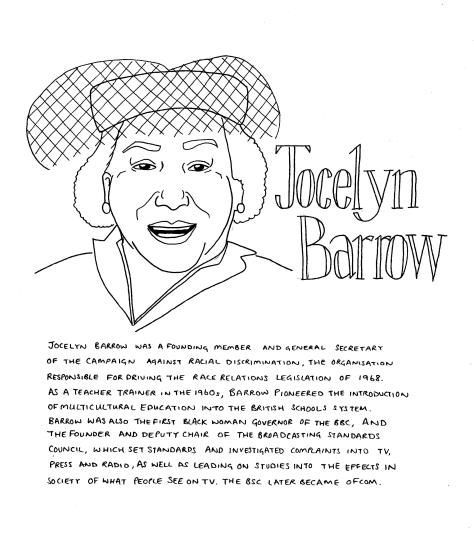
Line drawing of Jocelyn Barrow - she is looking forward and smiling with her mouth open. She is wearing a hat with a veil that covers her hair and forehead, and earrings. The text in the image is included in the body of the post.

Jocelyn Barrow was a founding member and General Secretary of the Campaign Against Racial Discrimination, the organisation responsible for driving the Race Relations legislation of 1968.

As a teacher trainer in the 1960s, Barrow pioneered the introduction of multicultural education into the British schools system.

Barrow was also the first black woman Governor of the BBC, and the founder and Deputy Chair of the Broadcasting Standards Council, which set standards and investigated complaints into TV, press and radio, as well as leading on studies into the effects in society of what people see on TV. The BSC later became Ofcom.
Black Histry Month: Nicola Adams

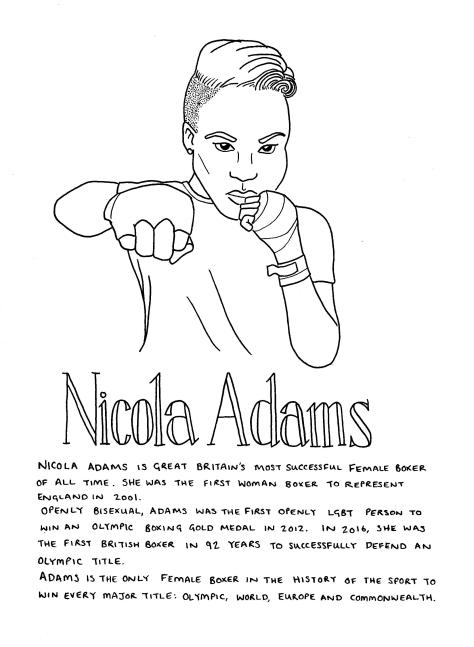
Line drawing of Nicola Adams - she is looking at the viewer face-on, with one fist to her face and the other punching forwards. She has short hair, shaved at the sides and curling over to the right on top. The text included in the image is in the body of the post.

Nicola Adams is Great Britain’s most successful boxer of all time. She was the first woman boxer to represent England in 2001.

Openly bisexual, Adams was the first openly LGBT person to win an Olympic boxing gold medal in 2012. In 2016, she was the first British boxer in 92 years to successfully defend an Olympic title.

Adams is the only female boxer in the history of the sport to win every major title: Olympic, World, Europe and Commonwealth.

Black History Month: Doreen Lawrence

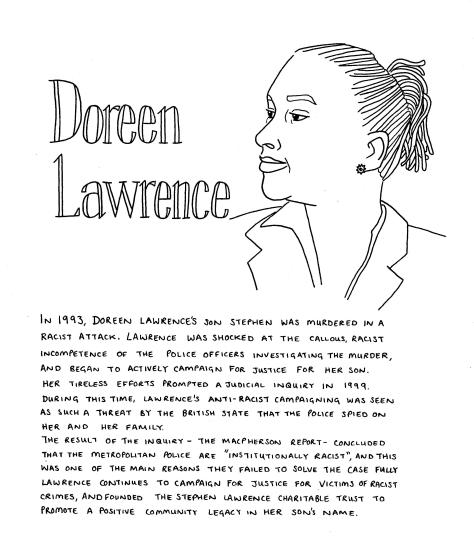
Line drawing Doreen Lawrence - a woman with thin dreadlocks looks to the left of the page. She is wearing a small stud earring in the shape of a star, and a shirt and blazer.

In 1993, Doreen Lawrence’s son Stephen was murdered in a racist attack. Lawrence was shocked at the callous, racist incompetence of the police officers investigating the murder, and began to actively campaign for justice for her son. Her tireless efforts prompted a judicial inquiry in 1999.

During this time, Lawrence’s anti-racist campaigning was seen as such a threat by the British state that the police spied on her and her family.

The result of the inquiry – the Macpherson Report – concluded that the Metropolitan Police are “institutionally racist”, and this was one of the main reasons they failed to solve the case fully.

Lawrence continues to campaign for justice for victims of racist crimes, and founded the Stephen Lawrence Charitable Trust to promote a positive community legacy in her son’s name.

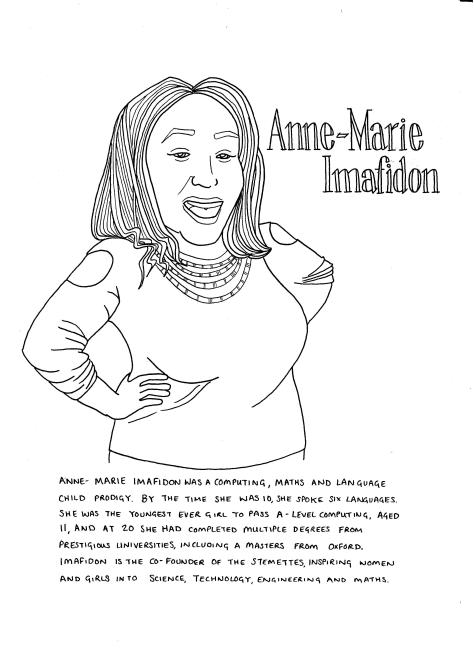
Black History Month: Anne-Marie Imafidon

Anne Marie Imafidon. She is looking to the viewer, smiling with her mouth open, with her hands on her hips. She is wearing a long-sleeved top with holes at the shoulders, and a necklace with mulitiple strands of beads. The text included in the image is included in the body of the post.

Anne-Marie Imafidon was a computing, maths and language child prodigy. By the time she was 10, she spoke six languages. She was the youngest ever girl to pass A-Level Computing, aged 11, and at 20 she had completed multiple degrees from prestigious universities, including a Masters from Oxford.

Imafidon is the co-founder of the Stemettes, inspiring women and girls into Science, Technology, Engineering and Maths.

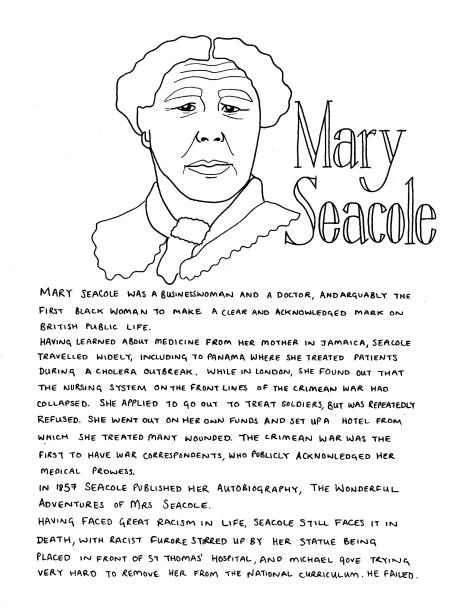
Black History Month: Mary Seacole

Mary Seacole

Mary Seacole was a businesswoman and a doctor, and arguably the first black woman to make a clear and acknowledged mark on British public life.

Having learned about medicine from her mother in Jamaica, Seacole travelled widely, including to Panama where she treated patients during a cholera outbreak. While in London, she found out that the nursing system on the front lines of the Crimean War had collapsed. She applied to go out to treat soliders, but was repeatedly refused. She went out on her own funds and set up a hotel from which she treated many wounded. The Crimean War was the first to have war correspondents, who publicly acknowledged her medical prowess.

In 1857 Seacole published her autobiography, The Wonderful Adventures of Mrs Seacole.

Having faced great racism in life, Seacole still faces it in death, with racist furore stirred up by her statue being placed in front of St Thoma’s hospiral, and Michael Gove trying very hard to remove her from the National Curriculum. He failed.

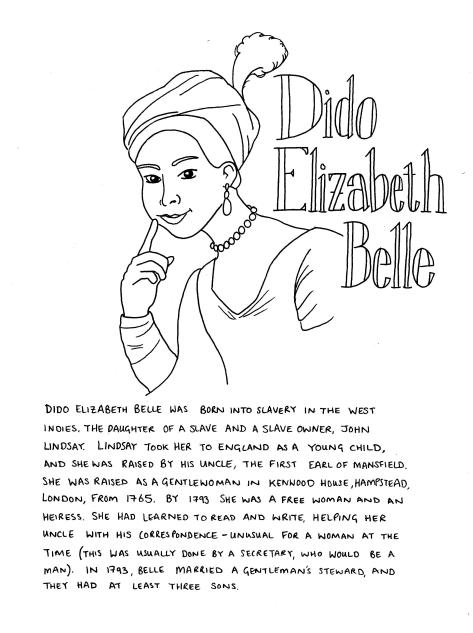
Black History Month: Dido Elizabeth Belle

Dido Elizabeth Belle - line drawing of a woman in a feathered head scarf. She looks to the veiwer, pointing to her face with one finger. She is wearing a string of pearls, a dress and shawl. The text included in the image is included in the body of the post..

Dido Elizabeth Belle was born into slavery in the West Indies, the daughter of a slave and a slave owenr, John Lindsay. Lindsay took her to England as a young child, and she was raised by his uncle, the First Earl of Mansfield.

She was raised as a gentlewoman in Kenwood House, Hampstead, London, from 1765. By 1793 she was a free woman and an heiress. She had learned to read and write, helping her uncle with his correspondence – unusual for a woman at the time (this was usually done by a secretary, who would be a man). In 1793, Belle married a gentleman’s steward, and they had at least three sons.

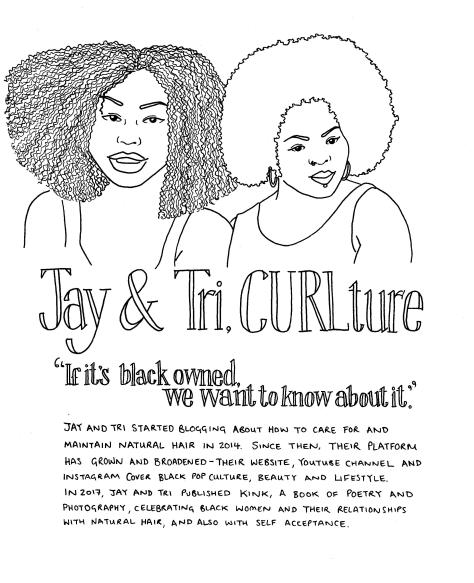
Black History Month – Jay and Tri, CURLture

Jay and Tri, CURLture

Jay and Tri started blogging about how to care for and maintain natural hair in 2014. Since then, their platform has grown and broadened – their website, Youtube channel and Instagram cover black pop culture, beauty and lifestyle.

In 2017, Jay and Tri published KINK, a book of poetry and photography, celebrating black women and their relationships with natural hair, and also with self-acceptance.

www.curlture.co.uk

Black History Month – Claudia Jones

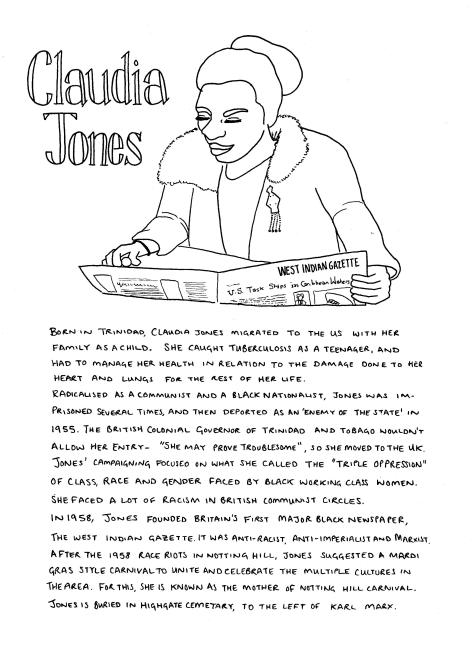
Claudia Jones (2)

Born in Trinidad, Claudia Jones migrated to the US with her family as a child. She caught tuberculosis as a teenager, and had to manage her health in relation to the damage done to her heart and luncgs for the rest of her lufe.

Radicalised as a communist and a Black Nationalist, Jones was imprisoned several times, and then deported as an ‘enemy of the state’ in 1955. The British Colonial Governor of Trininadad and Tobago would not allow her entry: “She may prove troublesome,” so she moved to the UK.

Jones’ campaigning focused on what she called the “triple oppression” of class, race and gender faced by black working class women. She faced a lot of racism in British communist circles.

In 1958, Jones founded Britain’s first major black newspaper, the West Indian Gazette. It was anti-racist, anti-imperialist and Marxist.

After the 1958 race riots in Notting Hill, Jones suggested a Mardi Gras-style carnival to unite and celebrate the multiple cultures in the aresa. For this, she is known as the Mother of Notting Hill Carnival.

Jones is buried in Highgate cemetary, to the left of Karl Marx.

Black History Month – Shirley Thompson

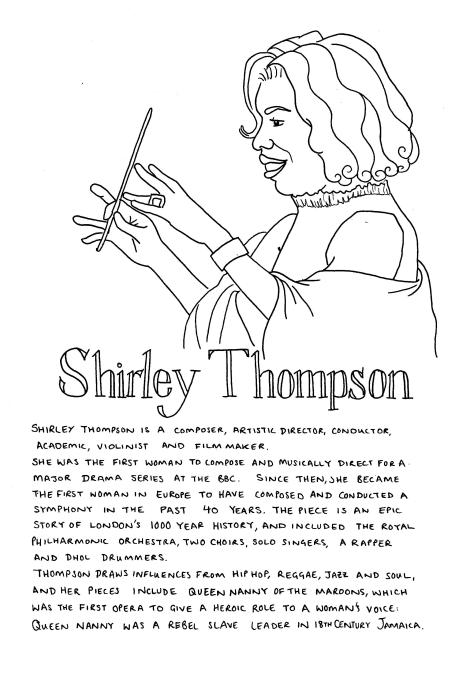
Shirley Thompson

Shirley Thompson is a composer, artistic director, conductor, academic, violinist and film maker.

She was the first woman to compose and musically direct for a major drama series at the BBC. Since then, she became the first woman in Europe to have composed and conducted a symphony in the past 40 years. The piece is an epic story of London’s 1000 year history, and included the Royal Philharmonic Orchestra, two choirs, solo singers, a rapper and dhol drummers.

Thomson draws influences from hop hop, reggae, jazz and soul, and her pieces include Queen Nanny of the Maroons, which was the first opera to give a heroic role to a woman’s voice. Queen Nanny was a rebel slave leader in 18th Century Jamaica.

Black History Month – Hope Powell

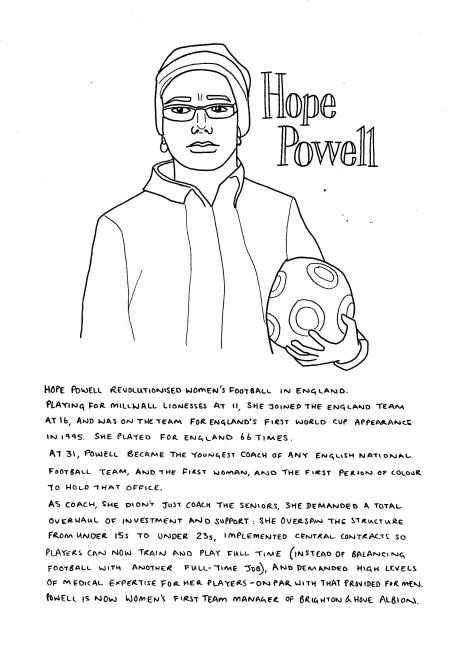
Hope Powell

Hope Powell revolutionised women’s football in England.

Playing for Millwall Lionesses at 11, she joined the England team at 16, and was on the team for Englans’ts first World Cup appearance in 1995. She played for Engald 66 times.

At 31, Powell became the youngest coach of any English national football team, and the first woman, and the first person of colour to hold that office.

As coach, she didn’t just coach the seniors, she demanded a total overhaul of investment and support: she oversaw the structure from Under 15s to Under 23s, implemented central contracts so players can now train and play full time (instead of balancing football with another full-time job), and demanded high levels of medical expertise for her players – on par with that provided for men.

Powell is now Women’s First Team Manager of Brighton & Hove Albion.